
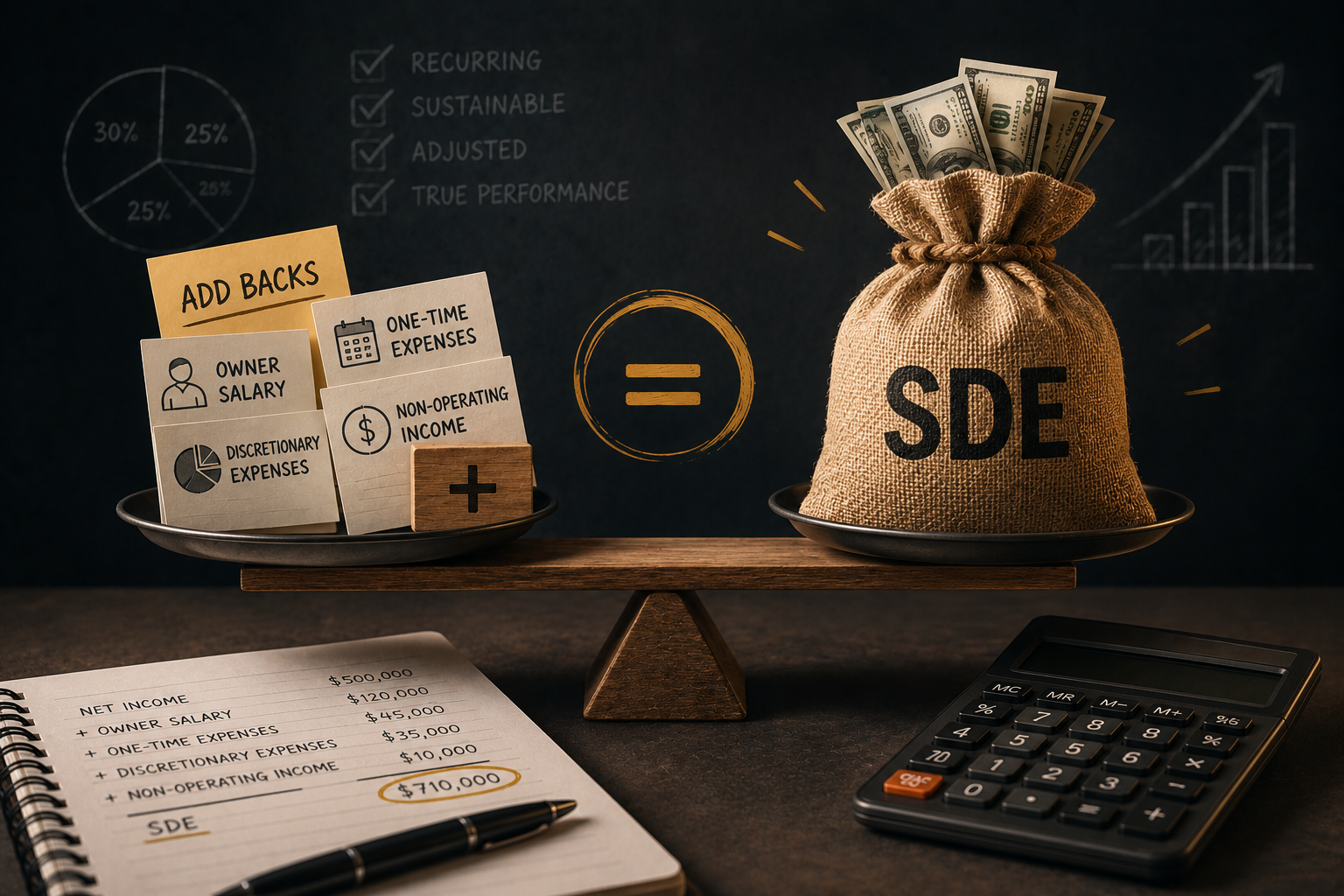
If you are selling a small business, there is one number that matters more than almost any other. It is called seller’s discretionary earnings, usually shortened to SDE. It is the foundation of how small businesses are valued, and understanding it is essential to understanding what your business is worth.
Most business owners have never heard of SDE before they start thinking about selling, yet it is the number buyers and brokers use to determine value. This guide explains exactly what SDE is, how to calculate it, and how it translates into your business’s sale price.
What Is Seller Discretionary Earnings?
Seller’s discretionary earnings is a measure of the total financial benefit that a single owner-operator derives from a business in a year. In plain terms, it is what the business actually puts in the owner’s pocket once you account for everything.
SDE matters because small business financial statements are usually structured to minimize taxable income, not to show profitability. Owners run personal expenses through the business, pay themselves a salary, and take various deductions. The net profit on a tax return is therefore much lower than the actual economic benefit the owner receives. SDE corrects for this to show the true earning power of the business.
How to Calculate SDE
SDE is calculated by starting with the business’s net profit and adding back several categories of expenses that would not transfer to a new owner or that represent owner benefits rather than true business costs.
Start with net profit from the tax return or profit and loss statement. Add back the owner’s salary and benefits. Add back personal expenses run through the business such as personal vehicles, phone, travel, and insurance. Add back interest, depreciation, and amortization. Add back any one-time or non-recurring expenses such as a lawsuit settlement or one-off equipment purchase. The result is your seller’s discretionary earnings.
An SDE Calculation Example
Consider a business with 150,000 dollars in net profit on its tax return. The owner pays themselves a 90,000 dollar salary. They run 25,000 dollars of personal expenses through the business. The business has 20,000 dollars in depreciation and 15,000 dollars in interest expense. There was also a one-time 10,000 dollar legal expense.
The SDE calculation would be 150,000 plus 90,000 plus 25,000 plus 20,000 plus 15,000 plus 10,000, which equals 310,000 dollars. So while the tax return shows 150,000 dollars in profit, the actual SDE is 310,000 dollars. That difference of 160,000 dollars dramatically changes what the business is worth.
How SDE Determines Business Value
Once SDE is established, business value is determined by applying a multiple to it. Most small businesses sell for somewhere between 2 and 4 times SDE, though the exact multiple depends on many factors.
Using the example above with 310,000 dollars in SDE, a 3x multiple would value the business at 930,000 dollars. A 2.5x multiple would value it at 775,000 dollars. A 3.5x multiple would value it at over 1 million dollars. This is why getting SDE right matters so much, and why understanding how to value a business before selling is essential.
What Affects the SDE Multiple
The multiple applied to your SDE depends on the risk and attractiveness of the business. Factors that increase the multiple include strong recurring revenue, a diversified customer base, limited owner dependency, consistent growth, and clean documented financials.
Factors that decrease the multiple include high customer concentration, heavy owner dependency, declining revenue, messy financials, and industry or market risk. A business with the same SDE can be worth significantly more or less depending on these factors. Improving them is the core of preparing a business for sale.
SDE vs EBITDA
SDE and EBITDA are related but used for different sizes of business. SDE is used for smaller owner-operated businesses, typically under 5 million dollars in sale price, and includes the owner’s salary as an add-back because a single owner-operator runs the business.
EBITDA, which stands for earnings before interest, taxes, depreciation, and amortization, is used for larger businesses where the owner is not the sole operator. EBITDA does not add back a full owner salary because larger businesses have professional management in place. As a business grows past a few million dollars in value, buyers shift from SDE multiples to EBITDA multiples.
Why Getting SDE Right Matters
Because SDE is the foundation of your valuation, errors in calculating it directly cost you money. Understating SDE by failing to identify legitimate add-backs means undervaluing your business. Overstating it with aggressive or unjustifiable add-backs means buyers will challenge your number during due diligence and lose trust.
This is why working with a broker or accountant experienced in recasting financials is valuable. They know which add-backs are legitimate and defensible and how to present them so buyers accept them. According to SCORE, a resource partner of the SBA, accurate financial preparation is one of the most important factors in a successful business sale. Sell With Millsaps helps business owners across 22 states calculate and document their SDE accurately to maximize their valuation.
Frequently Asked Questions
Q: What is seller discretionary earnings?
Seller’s discretionary earnings, or SDE, is a measure of the total financial benefit a single owner-operator derives from a business in a year. It represents what the business actually puts in the owner’s pocket and is the foundation of small business valuation.
Q: How do you calculate SDE?
SDE is calculated by starting with net profit and adding back the owner’s salary and benefits, personal expenses run through the business, interest, depreciation, amortization, and any one-time or non-recurring expenses. The result reflects the true earning power of the business.
Q: What is the difference between SDE and EBITDA?
SDE is used for smaller owner-operated businesses and adds back the owner’s full salary. EBITDA is used for larger businesses with professional management and does not add back a full owner salary. Businesses typically shift from SDE to EBITDA multiples as they grow past a few million dollars in value.
Q: What SDE multiple do small businesses sell for?
Most small businesses sell for between 2 and 4 times SDE. The exact multiple depends on factors including recurring revenue, customer diversification, owner dependency, growth trend, and the quality of the business’s financials.
Q: Why does SDE matter when selling my business?
SDE is the foundation of your business valuation. The sale price is determined by applying a multiple to SDE, so calculating it accurately and documenting legitimate add-backs directly determines what your business is worth. Errors in SDE directly cost you money at sale.