Oklahoma gets underestimated as a business market, including by the people who own businesses here.
The reputation is energy, and energy is genuinely significant. But the state’s economy is broader than that now, and the buyer pool reflects it. Aerospace and aviation maintenance, healthcare, logistics, government, and agriculture all support real businesses with real buyers.
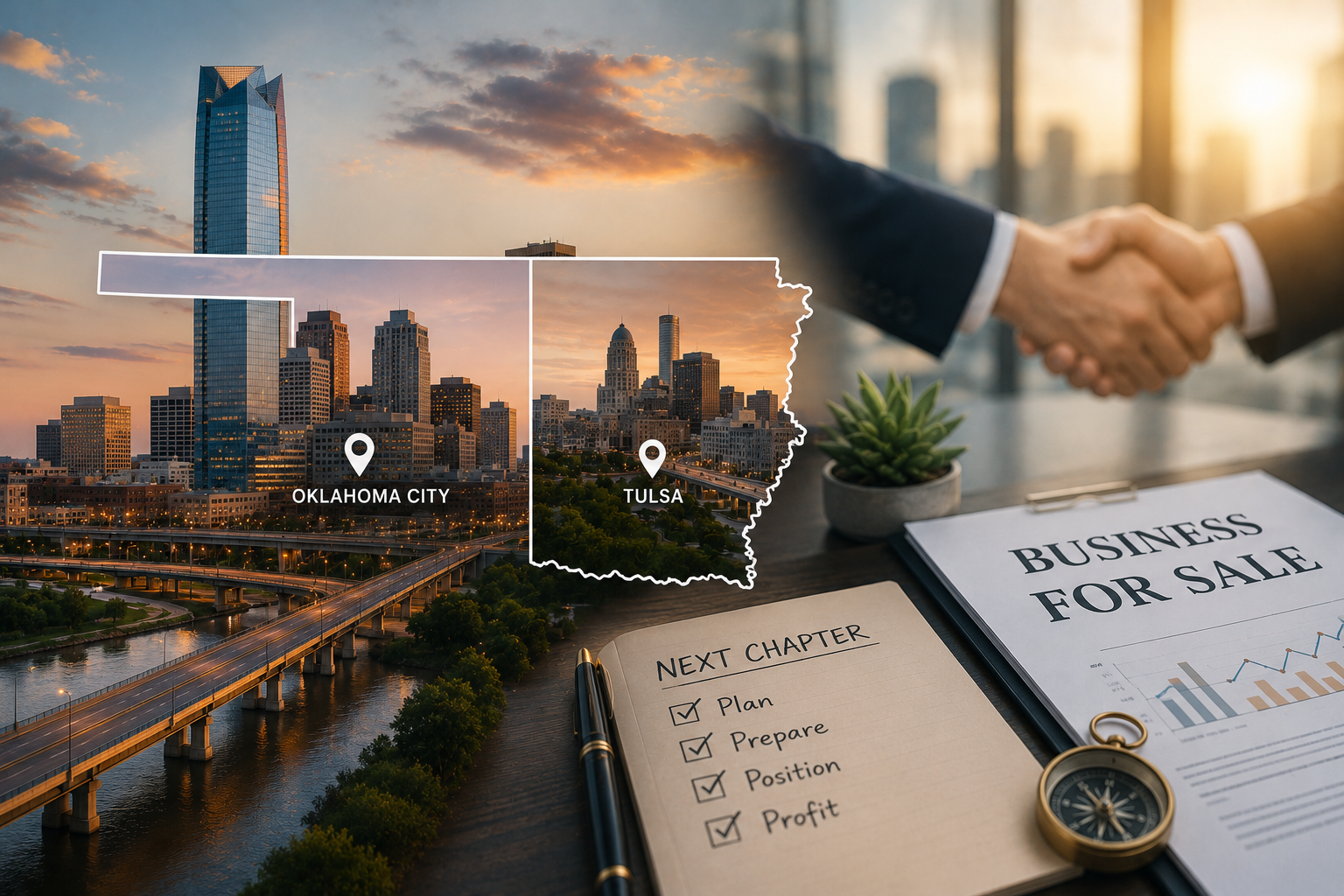
This guide covers what your Oklahoma City or Tulsa business is worth, who is actually buying, how the sale process runs, and what to fix before you go to market.
What the Oklahoma Market Looks Like Now
Oklahoma City and Tulsa are different markets, and it helps to understand both.
Oklahoma City has an unusually diversified base for a metro its size. It is the state capital, which means substantial government employment that stays stable regardless of what oil prices do. Tinker Air Force Base is one of the largest employers in the state and anchors a serious aircraft maintenance and repair industry. Energy companies remain headquartered here. There is a strong agriculture and cattle sector in the surrounding region. And the city has spent decades investing in its downtown, which changed the perception of the market considerably.
Tulsa has its own character. The energy heritage runs deep, with pipeline and energy services companies headquartered in the city. But Tulsa also holds what is arguably the largest aircraft maintenance base in the world, tied to commercial aviation. Manufacturing has a real presence. The city has also drawn attention for actively recruiting remote workers to relocate there, which has brought in a steady flow of new residents with money and, in some cases, an interest in owning a business.
What both cities share is cost. Oklahoma is inexpensive to operate in compared with almost anywhere on the coasts. Commercial rent, wages, and housing all run well below national averages. For a buyer coming from a more expensive market, the math on an Oklahoma business can look very attractive.
For the full state picture, our Oklahoma business brokers page covers valuations and buyer demand across both metros and the rest of the state.
Which Oklahoma Businesses Buyers Want
Certain categories consistently attract buyers here.
Home services and trades are strong across both metros. HVAC, plumbing, electrical, roofing, and landscaping. Oklahoma weather does a lot of the work here. Extreme heat, real winters, and enough severe storm activity that roofing and exterior restoration businesses stay genuinely busy. Buyers understand this demand is not optional. Service agreements make these businesses considerably more valuable.
Energy services businesses have a specialized and knowledgeable buyer pool in Oklahoma that does not exist in most states. Oilfield services, equipment suppliers, and support operations attract buyers who understand the sector’s cycles and know how to value a business inside it. If you operate in this space, your buyer pool is smaller but far more sophisticated.
Aerospace and aviation maintenance businesses attract growing attention, particularly around Tinker in Oklahoma City and the maintenance base in Tulsa. Buyers with sector experience specifically target this region because the workforce and supplier relationships here are hard to replicate.
Manufacturing and industrial businesses see steady demand, with buyers valuing the experienced regional workforce and the lower cost structure.
Healthcare practices attract buyers across both metros. Dental offices, physical therapy clinics, home health agencies, and specialty practices all find interest from clinicians with financing and from groups building multi location platforms.
Construction and specialty contracting stays busy with ongoing development in both metros.
Agricultural services businesses, including equipment dealerships, farm supply, and support operations, have a motivated buyer pool that reflects the state’s agricultural economy.
What Your Oklahoma Business Is Worth
Here is how the pricing works.
Small businesses are valued on seller’s discretionary earnings, shortened to SDE. The term sounds technical but the concept is simple. SDE is how much money the business actually puts in one owner’s pocket over a year.
Take the profit on your tax return, then add back everything that is really an owner benefit rather than a genuine operating cost. Your salary. Personal expenses running through the business, like a truck, phone, or insurance. Depreciation, which is a paper entry rather than cash leaving. Interest. Any one time cost that will not repeat.
An example. Your return shows one hundred and twenty thousand in profit. You pay yourself seventy five thousand. Nineteen thousand of personal expenses run through the business. Depreciation is twenty six thousand, interest is ten thousand. Your real SDE is two hundred and fifty thousand dollars.
That is more than double the tax return figure. This gap is why the recast matters so much. Our full guide on seller’s discretionary earnings walks through it in detail.
Oklahoma businesses generally sell between two and three and a half times SDE. On the example above, that is roughly five hundred thousand to eight hundred and seventy five thousand dollars. Energy services businesses with strong contracts and aerospace businesses with specialized capabilities can push higher, because their buyer pools are specialized and motivated.
Larger businesses earning above five hundred thousand a year get valued on EBITDA instead, generally three and a half to six times.
What Moves Your Number Up or Down
The multiple is a measure of risk.
In your favor. Recurring revenue through contracts or service agreements. Customers spread out so no single account is dangerous. A business that runs without you. Clean books matching your tax returns. Steady or growing revenue. A trained team that plans to stay.
Against you. Heavy dependence on you personally, which remains the most common issue everywhere. One customer at thirty percent or more of revenue. Bookkeeping that does not reconcile. Declining sales. Aging equipment or vehicles. A lease with little term remaining.
There is one Oklahoma specific point worth being direct about. If your business is tied to energy, buyers will look closely at how your revenue moved through the last several commodity cycles. That is not a reason to avoid selling, but it does mean you should be ready to show the pattern honestly and explain how the business performs in a down cycle. A business that stayed profitable through a soft period is worth considerably more than one that only looks good at the top of a cycle.
Who Buys Oklahoma Businesses
Knowing your likely buyer changes how you prepare.
Individual buyers are the most common for businesses under about two million dollars. Often people who spent years in a corporate or industry role, saved, and now want to run something of their own. Many use SBA financing, which lets them buy with a modest down payment and widens your pool considerably. It also adds sixty to ninety days at closing.
Relocating buyers are a growing factor, particularly in Tulsa. The cost of living here compared with coastal markets means someone arriving with capital from a house sale can buy a business outright that would be far out of reach where they came from.
Strategic buyers are existing companies in your industry expanding. A regional HVAC company acquiring a smaller one for its technicians and customer list. In energy services and aviation especially, consolidation happens regularly. These buyers often pay the most because your business is worth more inside their operation than standing alone.
Private equity groups and search funds target businesses earning roughly five hundred thousand or more. They look at Oklahoma partly because valuations here compare favorably against more competitive markets while the businesses are just as real.
Our guide on how to find a buyer for your business covers how each group gets reached.
How the Sale Process Works
Here is the full sequence.
Valuation comes first. Three years of financials reviewed, recast properly, compared against real comparable sales, and turned into a supportable asking price.
Then packaging. Financials organized and a blind profile written that describes the business without naming it.
Confidential marketing follows, reaching buyer networks, listing platforms, and strategic buyers directly.
Buyers who respond sign a non disclosure agreement, then get screened for funding and relevant experience before seeing real financials.
Qualified buyers meet with you. Serious ones submit a letter of intent covering price, structure, and terms. Our letter of intent guide explains what to watch for.
Due diligence runs thirty to sixty days while the buyer verifies everything. Our article on due diligence lists what gets requested.
Closing follows, with attorneys handling documents and the transfer of leases, licenses, and funds. Then a transition period.
Most Oklahoma sales close six to twelve months after listing, plus SBA time if applicable. Our guide on how long it takes to sell a business breaks down each stage.
Preparing Your Oklahoma Business for Sale
Preparation is where the money is made.
Clean up the books. Three years of tax returns, profit and loss statements, and balance sheets that agree with each other. Buyers cannot value what they cannot verify, and they assume the worst about anything unclear.
Get the recast done with your accountant. Document every legitimate add back. This one step routinely adds more to a final price than anything else you could do in your last year.
Reduce dependence on you. If you personally handle the estimating, the key customer relationships, and every decision, buyers see a job rather than a business. Move relationships to your team. Write down how the work gets done. Take two weeks off and see what breaks.
If you are in an energy adjacent business, prepare your cycle story. Pull the numbers showing how the business performed through both strong and weak periods. Buyers will ask, and having it ready and honest builds far more confidence than being caught flat footed.
Check your licensing. Oklahoma contractor and professional licensing rules vary, and some credentials are tied to a person rather than a business. The Oklahoma Secretary of State business services page is a reasonable starting point for entity questions.
Our complete guide on preparing a business for sale covers the full checklist.
Keeping It Confidential
Oklahoma business communities are close knit, particularly in energy, aviation, and the trades. Supplier reps talk. Trade associations talk. Word moves quickly in both metros.
A structured process protects you. The business gets marketed without its name. Buyers sign a non disclosure agreement before learning anything identifying. They prove funding before seeing your numbers. Information comes out in stages.
The honest risk is not the marketing. It is the owner mentioning it to a supplier or a longtime employee months too early. Keep it to your attorney, accountant, and broker until you are genuinely ready.
Mistakes Oklahoma Owners Make
Timing the sale to a cycle peak and pricing on the best year. Buyers will normalize your numbers across several years. If your asking price only works using your strongest year, expect it to be challenged.
Assuming the buyer must be local. Many Oklahoma owners quietly approach one competitor. Often the strongest offer comes from a strategic buyer out of state or a relocating individual buyer.
Letting performance slip during the process. Buyers watch your numbers right through to closing. A soft quarter after the letter of intent invites renegotiation.
Focusing only on the headline price. An offer with a large earnout attached is not the same as cash at closing.
Skipping tax planning. Whether the deal is structured as an asset sale or a stock sale changes what you keep. Our guide on asset sale versus stock sale explains the difference. Our article on mistakes when selling a business covers the rest.
What a Broker Costs
Most Oklahoma brokers work on commission, typically eight to twelve percent of the sale price, with nothing paid upfront. You pay at closing, and only if it closes.
What that buys is reach and process. A buyer network including out of state strategics and relocating buyers you would not find alone. A valuation based on actual comparable sales. Confidential marketing. Buyer screening. And someone who has seen where deals break.
The biggest single value is competition. One buyer means you take their terms. Several competing changes the entire conversation. Our guide on what a business broker charges explains the fee structures.
Where to Start
You do not need to be ready to sell to find out what your business is worth. Most owners who eventually do well started asking a year or more before they acted.
That number tells you whether your plans work, what is worth improving, and how much time you actually have.
Sell With Millsaps works with owners across Oklahoma City, Tulsa, and twenty two states nationwide, with full confidentiality and no upfront fees.
Get a free confidential valuation of your Oklahoma business. No cost, no obligation, and nobody has to know you asked.
Frequently Asked Questions
How do I sell my business in Oklahoma City or Tulsa?
Start with a professional valuation based on your real financials and current market conditions in your metro. Your business is then packaged into a confidential profile and marketed to qualified buyers who sign a non disclosure agreement before learning who you are. From there it moves through offers, due diligence, and closing.
What is my Oklahoma business worth?
Most Oklahoma businesses sell for two to three and a half times seller’s discretionary earnings, which is your profit plus your salary, personal expenses run through the business, depreciation, and one time costs added back. Energy services and aerospace businesses with specialized capabilities can go higher. Larger companies earning above five hundred thousand a year are valued on EBITDA at three and a half to six times.
How long does it take to sell a business in Oklahoma?
Most sales close within six to twelve months of going to market. Clean financials and recurring revenue speed things up. SBA financing adds roughly sixty to ninety days once a buyer’s loan is in process.
What do business brokers in Oklahoma City and Tulsa charge?
Most Oklahoma brokers work on a success based commission of eight to twelve percent of the final sale price with no upfront fees. Nothing is owed until the deal closes.
Does the energy cycle affect what my business is worth?
If your business is energy related, yes. Buyers will look at how your revenue moved across several commodity cycles rather than just your best year. A business that stayed profitable through a soft period is worth considerably more than one that only looks strong at a peak. Having that history documented and explained honestly builds real confidence.
Can I sell my Oklahoma business confidentially?
Yes. Your business is marketed under a blind profile with no name or exact location shown. Buyers only learn your identity after signing a non disclosure agreement and proving they can fund the purchase. This matters in Oklahoma energy, aviation, and trades circles, which are tightly connected.
Do buyers from outside Oklahoma actually look here?
Regularly. Oklahoma’s low operating costs mean a business with the same earnings sells for less here than in more expensive markets, which attracts both relocating individual buyers and private equity groups looking for value. Marketing only to local buyers leaves a meaningful part of the market untouched.